
Caritas, the CEOE Foundation and CAEB introduce the employment inclusion project “Emplea lLab” to employers in Menorca
- This is a pilot inclusion project that aims to improve the employability of people at risk – recipients of the Minimum Subsistence Income (IMV) – who will receive basic, transversal, and digital skills to find employment.
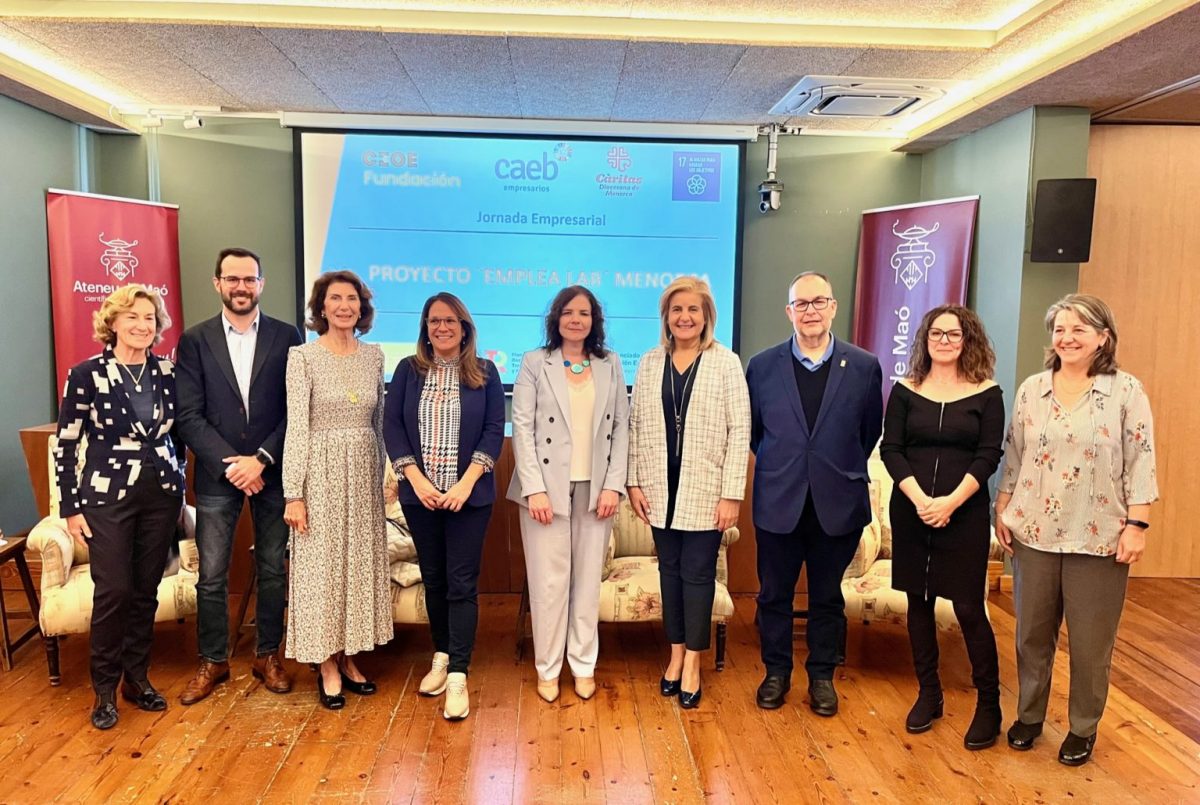
- The event, held at the headquarters of the Ateneu de Maó, was attended by the president of CAEB, Carmen Planas; the secretary general of Objectives and Inclusion Policies, Milagros Paniagua; the president of the CEOE Foundation, Fátima Báñez; the secretary general of Cáritas Menorca, Guiem Ferrer; and the president of the Consell de Menorca, Susana Mora.
This morning, Cáritas Española, the CEOE Foundation and CAEB presented the “Emplea Lab” work inclusion projectto Menorca’s employers. This project is financed through the European Union’s Next Generation Funds and has the support of the Ministry of Inclusion, Social Security and Migration, and the Adecco Foundation. Emplea Lab is an inclusion pilot project whose objective is to improve the employability of people at risk – recipientsof the Minimum Subsistence Income (IMV) – through the improvement of their basic, transversal, and digital skills to find and keep a job.
The event, held at the headquarters of the Ateneu de Maó, was attended by the president of the Balearic employers’ association, Carmen Planas; the general secretary of Objectives and Inclusion and Social Welfare Policies, Milagros Paniagua; the president of the CEOE Foundation, Fátima Báñez; the general secretary of Cáritas Menorca, Guiem Ferrer; and the president of the Consell Insular de Menorca, Susana Mora, who delivered the closing speech.
The event held today serves as the launch of this ambitious inclusion project that aims to measure how the participation in intensive processes or itineraries of socio-occupational insertion may impact the ability of people in precarious situationsto access jobs. “It is both a source of pride and a responsibility that the competent institutions have chosen the island of Menorca to launch this pilot project, which will also be conducted in 10 other Spanish provinces and is expected to involve nearly 2,000 people,” said Carmen Planas during the opening of the meeting.
Together with CAEB, the CEOE Foundation will explore business prospects in Menorca with the aim of reaching collaboration agreements with companies and learning about job vacancies on the island, with the aim of facilitating labour inclusion. This prospecting work will also result in a diagnosis of Menorca’s real labour needs. The CEOE Foundation, in collaboration with Caritas services, will also carry out the intermediation step, coordinating job offers and referring suitable participants.
The methodology developed for the implementation of Emplea Lab has a strong social innovation component, as it requires conducting social research. The aim is to find out whether guidance, training and support in the job search process have an impact on the employability of the candidates.
The value of the business sector
One of the hypotheses that this project aims to test is the contribution that the business sector is able to makethrough its participation in the process of identifying vacant jobs and the subsequent intermediation between companies and individuals at risk of exclusion. The outcome will help in the design of public policies, especially those focused on vulnerable populations or on people who suffer the greatest difficulties in accessing employment.
From CAEB, Carmen Planas added that “the participation of our business fabric is fundamental in all employment processes, we are key players in job creation, and we are key players in promoting quality employment for all, especially those who need it the most. To this end, at the employers’ association, we connect those companies and social organisations within the Balearic Islands who are aware of the importance of training and integrating young people into the labour market because they have a lot to contribute to society. With everyone’s participation, we will take another step forward in analysing the labour needs in Menorca, and we will help to fill the vacancies in the island’s labour market and improve the quality of life, ensuring growth and well-being”.
Milagros Paniagua, Secretary General for Social Inclusion and Social Welfare Objectives and Policies, pointed out that “it is essential to get companies involved in public initiatives that fight poverty and exclusion, such as the Emplea Lab project, which works intensively to improve the employability of people at risk”. The Ministry of Inclusion acknowledges this collaboration through the Social Inclusion Seal.
From the CEOE Foundation, Fátima Báñez said that Emplea Lab “is a cutting-edge project that should be a bridge to employment and a reference in terms of inclusion”. “With Caritas’ leadership and in an alliance that is focused on the Spanish society’s best interest, the CEOE Foundation will channel the social commitment of our companies to integrate the most vulnerable people through training and employment. An alliance for the people that seeks to become a reference in social innovation and a growth driver based on a united front. This alliance proves that Spanish companies are still using their full capacity to serve the people so thatwe achieve excellence as a society”, she added.
Báñez also stressed that “companies are key to the present and future of Spain and continue to create opportunities, given that they provide 8 out of every 10 jobs and 50 percent of our country’s annual social wealth”. “Together we can go further and make a greater social impact”, she concluded.
On behalf of Cáritas Menorca, Guiem Ferrer stated that “the people we help at Cáritas need more than just a catch of fish to survive, they need to learn how to fish, and they need to find someone to hire them not just so they can earn a living, but also to do so with dignity. Work is the cornerstone of integration into society and the community. Companies and administrations play an essential role in this scenario”. For many years now, Caritas Menorca has been working to provide guidance and socio-occupational training. Last year alone, Caritas helped 748 people on the island in our Employment Guidance Service, of which more than 500 were women, and only 50 percent of them had studied beyond secondary school”, concluded Ferrer.
Finally, the president of the Consell Insular de Menorca, Susana Mora, described Emplea Lab as a win-win project, considering that the private sector is key not only to the economic development, but also to the social progress of our community. The right to work is a basic right and a fundamental pillar in any person’s life project. With initiatives like this, we give people who are not finding it easy to find a job a new opportunity to start over”.
During the presentation of Emplea Lab in Mahón, a round table discussion was held with the participation of Ángel Sánchez, general coordinator of the CEOE Foundation; Mar Pons, coordinator of the Social Inclusion and Employment Programme of Cáritas Menorca; Miriam Cuerva, island delegate in Menorca of the Balearic Islands Employment Service (SOIB); and Luís Anglés, manager of the company Bonita Menorca. This initiative was discussed in depth, as well as the situation and/or employability needs of the Balearic Islands and, specifically, the island of Menorca.
Share on:


Contenidos
La Alianza #CEOPorLaDiversidad, premiada en los V Reconocimientos go!ODS a la innovación en la Agenda 2030

The CEOE Foundation, Cáritas and CEO introduce the EmpleaLab labour market inclusion project in Ourense
